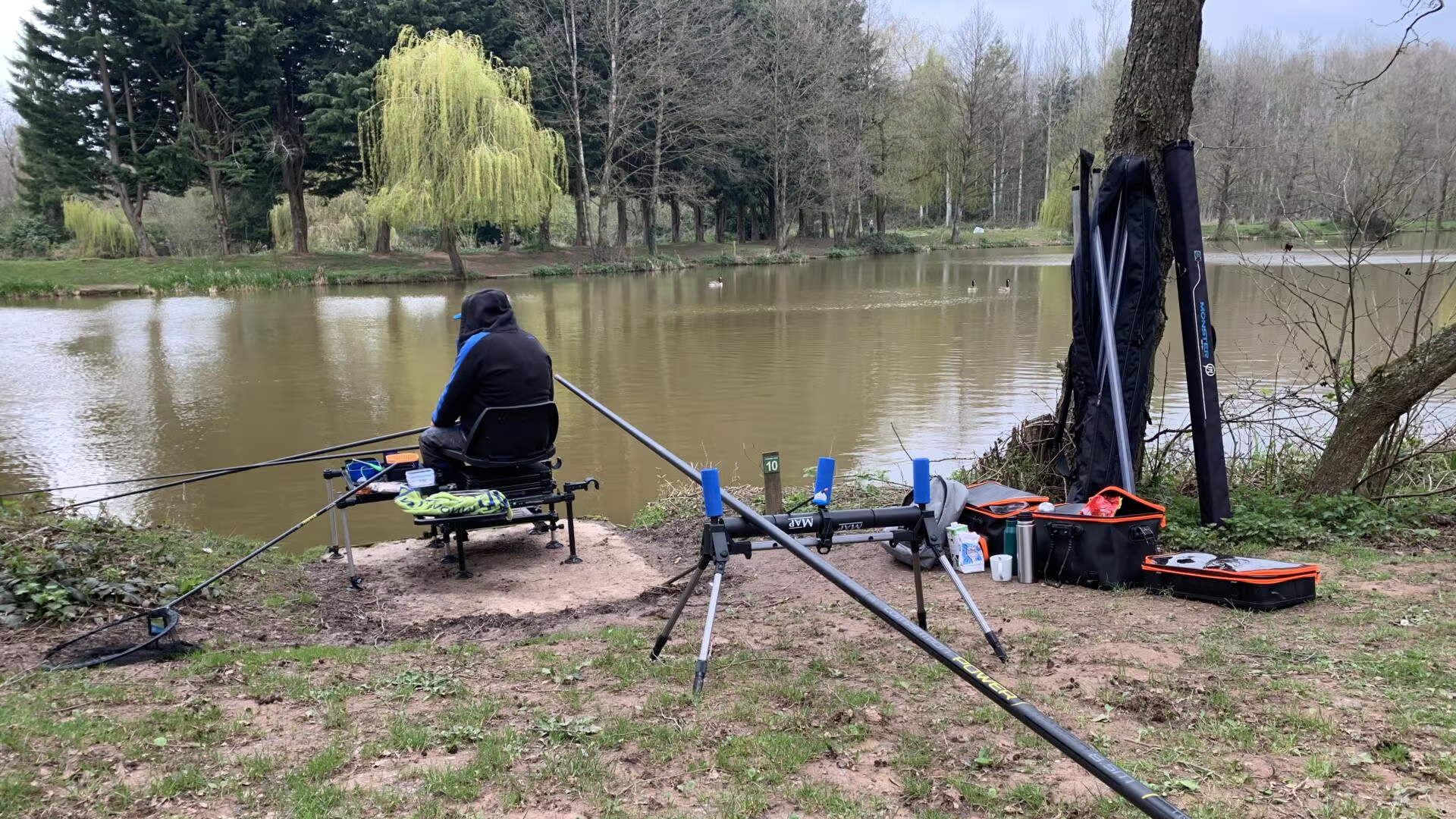

When temperatures plummet and most commercial species switch off, the F1 carp remains your most reliable target. But cold-water F1 fishing demands a completely different approach — here's everything you need to know.
There's a reason experienced match anglers smile when they draw a well-stocked commercial in winter. While everyone else is crossing their fingers for a moody carp to show, the angler who understands cold-water F1 fishing is quietly and methodically putting fish in the net. F1s are extraordinary creatures — a hybrid of common carp and goldfish, they retain the hardiness of both parent species and will feed confidently in water temperatures that shut ordinary carp down entirely.
But feeding in cold water and feeding freely are very different things. Winter F1s are cautious, lightly competitive, and exquisitely sensitive to anything that feels wrong — a hook that's too heavy, a rig that drags unnaturally, an elastic that jolts the fish on the strike. This is finesse fishing at its most demanding, and getting it right is one of the most satisfying skills a match angler can develop.
Winter F1 fishing is a test of everything — your tackle, your patience, your reading of the swim. Get it right, and you'll be catching when others are staring at still floats.
Why F1s Are the Perfect Winter Target
Understanding what makes F1s different from standard carp helps you fish for them more intelligently. The F1 hybrid — created by crossing common carp with goldfish — has a faster metabolism than a true carp at low temperatures. While a common carp in four-degree water may virtually stop feeding altogether, an F1 will continue to search for food, albeit much more cautiously and selectively.
Their compact, deep-bodied shape also means they're efficient swimmers in cold, dense water — they expend less energy moving than a larger common carp would, which means they're more willing to move to a bait rather than waiting for it to come to them. On hard winter days when the venue is fishing tough, a few well-placed F1s can be the difference between a respectable weight and an embarrassing blank.
They also tend to shoal tightly in winter, which is both a blessing and a challenge. Find the shoal and you can fish very efficiently, catching several fish in quick succession before they spook. Fail to locate them and you can spend an entire session on the wrong line, wondering where the bites have gone.
Reading Winter Conditions: Finding Cold-Water F1s
Cold water changes the rulebook entirely. In summer, F1s roam freely across a fishery, competing hard for food and covering large areas of water. In winter, they conserve energy, shoal tightly, and move very little during the day. You might find them sitting at six metres one day and fourteen metres the next — often for no obvious reason — but they will rarely roam freely between areas.
Finding the fish before you start feeding is absolutely critical. This means plumbing carefully across several lines before committing to any of them, and being prepared to experiment with distances and depths throughout the session. Don't fall into the trap of feeding a line simply because it's where you'd expect to find them — winter F1s don't always read the same script.
• Water clarity — cold water clears dramatically, making fish far more aware of their surroundings. Heavy rigs, strong elastics, and poorly-presented baits will spook fish quickly. In clear winter conditions, a tiny mismatch in presentation — a hook slightly too large, a float that drags fractionally — can cost you bite after bite without you ever knowing why.
• Light levels — F1s tend to feed most actively during the warmest, brightest part of the day in winter, typically between late morning and mid-afternoon. Don't be disheartened by a quiet start; the swim can come alive as the sun climbs and the surface temperature nudges upward even slightly.
• Depth — in cold spells, F1s often drop to the deepest water available, seeking out the most thermally stable environment. On most commercials that means fishing at full depth or even slightly over, rather than the mid-water presentations that work so well in warmer months.
• Wind and temperature — a mild south-westerly that raises the temperature even by a degree can transform winter fishing. A hard north or east wind does the opposite. Learn to read the forecast and adjust your expectations accordingly.
The discipline of finding fish before feeding them is a hard habit to build, but it transforms winter results. The angler who spends the first fifteen minutes plumbing and observing, rather than rushing to put bait in the water, will invariably outperform the one who fires straight in on an assumed line.
Scaling Down: Lines, Hooklengths & Hook Patterns
There is no aspect of winter F1 fishing where scaling down is optional. The combination of clear water, cautious fish, and light feeding means that every element of your tackle needs to be as light and unobtrusive as possible.
|
Main line |
0.18mm — strong enough for bonus carp, fine enough not to spook fish |
|
Hooklength — standard |
0.16mm — the everyday winter F1 setup |
|
Hooklength — tough days |
0.14mm — when bites are very hard to come by |
|
Hook size |
18–20 for maggot or pinkie; 16 for soft pellet or caster |
|
Hook pattern |
Fine wire barbless — light, sharp, minimal bait masking |
Hook sharpness in winter cannot be overstated. Cold-water F1s mouth baits extremely delicately — they're not sucking them in aggressively as they would in summer. A slightly blunt hook that fails to connect on a tentative bite in cold conditions might cost you two or three fish per session. Check your hooks regularly and change them at the first sign of any blunting.
The step down to 0.14mm hooklengths is something many anglers resist because they're worried about breakages. In reality, with the right elastic choice and a smooth, controlled strike, 0.14mm is more than adequate for winter F1s. What it gives you in return — more bites and more confident takes — usually outweighs the very occasional loss.
Elastic Selection: Cushioning the Cold-Water Bite
Elastic choice in winter F1 fishing is one of the most debated topics among commercial match anglers, and with good reason — get it wrong in either direction and you'll struggle. Too stiff and you'll bump fish on the strike; too soft and you'll lose bonus carp in the upper double figures that occasionally blunder onto the hook.
• Hollow 10–12 — the go-to recommendation for most winter F1 sessions on well-stocked commercials. Hollow elastic has a progressive, cushioning action that absorbs the shock of a strike without jarring the fish. It handles the delicate mouthing bites of cold F1s while still retaining enough power to land fish quickly and minimise stress.
• Solid 8–10 — better suited to smaller venues, silver-dominant waters, or very hard days where every single bite is precious. Softer and more direct, this elastic gives superb bite conversion but offers less protection if a better fish shows.
• Hollow 8 — a useful middle ground. Slightly softer than a 10–12 but still with enough backbone for a decent F1. Worth having set up as a second option if the harder elastic is bumping fish.
One often-overlooked factor is elastic length. A shorter elastic section transmits more shock; a longer section gives more cushion. In winter, if you can add an extra section of elastic and fish on a longer top kit, the additional cushioning can noticeably improve bite conversion on tentative takes.
The right elastic doesn't just protect your hooklength — it changes how fish behave on the hook. A smooth, progressive elastic keeps fish calm and controlled; a stiff one creates panic, and panicking fish bump off.
Feeding Strategy: The Art of Doing Almost Nothing
Feeding in winter F1 fishing requires a complete reset of the instincts you've built through summer sessions. The temptation to keep feeding — to put bait in regularly, to try to draw fish up — has to be actively suppressed. Over-feeding in cold water is the single most common mistake winter anglers make, and it kills sessions stone dead.
In cold water, F1s have a much-reduced appetite. Their metabolism has slowed, their digestive system is less active, and they simply cannot consume food at anything like the rate they would in summer. A shoal of fifteen F1s that would mop up a pint of maggots in a warm-water session might collectively eat just a dozen in a cold one. Feed beyond their appetite and the shoal becomes nervous and uncompetitive — at which point bites stop entirely.
• Start negatively — begin with virtually no feed. A few loose maggots or a tiny pinch of micros via a toss pot. Watch for signs of fish before introducing anything more substantial.
• Feed in rhythm with the bites — once you're catching, mirror your feeding to your catch rate. One or two maggots after every fish, or every other fish on slow days. The goal is to keep the shoal interested without filling them up.
• Use a toss pot — accuracy is everything in winter. Every piece of loose feed should land on your feeding spot, not scattered across the swim. A toss pot on the end of your top kit puts feed exactly where you need it, every time.
• Groundbait sparingly — if you use groundbait at all in winter, think in terms of teaspoon-sized amounts, not golf balls. A tiny squeeze of dark, fishmeal-based groundbait can attract and hold F1s, but anything more substantial risks filling them up.
The feeding rhythm that works best is one most anglers find uncomfortable — it feels like you're not doing enough. But the transformation in bite frequency when you trust the process and hold back is often dramatic. Less, in winter F1 fishing, is almost always more.
Rigs and Floats: Presentation is Everything
Every element of your rig needs to be working in favour of presentation. In clear, cold water, fish are watching everything — the way the bait moves, the way it settles, the way the float sits. Any element that looks or feels unnatural will result in refusals rather than bites.
• Float choice — a slim-bodied 4x14 with a fine bristle tip is the winter F1 standard. The slim body cuts through surface drift and the fine tip registers the delicate dinks and lifts that cold-water F1s produce. Avoid floats with bulbous bodies or thick tips in winter — they simply don't register the bites.
• Shotting pattern — string the shot out in a spread pattern for a slow, natural descent. In cold water there's no rush to get the bait to the bottom; a gently falling rig that mimics natural food filtering down is far more attractive than a bulk-shotted rig that drops fast. Consider stringing shot from number 8s down to number 10s for maximum sensitivity.
• Fishing slightly overdepth — setting the float so the bait rests gently on the bottom, perhaps half an inch to an inch overdepth, steadies the rig and gives F1s a stationary target. Moving bait in cold water can deter takes; settled bait encourages them.
• Hooklength length — in winter, a longer hooklength of ten to twelve inches often outperforms the shorter versions used in summer. The extra length gives the hookbait a more natural, independent movement that cold-water F1s find less threatening.
In clear winter water, every detail is magnified. Your rig is not just a delivery mechanism — it's the last thing between you and a bite. Make it invisible.
Bait Options for Winter F1 Fishing
Bait choice in winter is less about variety and more about precision. F1s are not actively competing for food, so the bait that works is usually the one that triggers a reaction most efficiently — small, natural, and easy to eat.
• Maggots — the undisputed winter F1 bait on most commercials. A single red or white maggot on a fine-wire 18 or 20 is deadly. Double maggot can work on slightly better days but risks overloading cautious fish. On very hard sessions, a pinkie hook bait with maggot loose feed can be the edge that gets bites when nothing else will.
• Pinkies — smaller and lighter than maggots, pinkies fall more slowly through the water and are often the difference-maker on the hardest winter days. They're also excellent mixed into a small amount of groundbait for feed.
• Soft expanders — small 4mm expanders lightly pumped so they retain some buoyancy can be exceptional for winter F1s, particularly on pressured venues where the fish have seen thousands of maggots. The subtle, slow-sinking action of a barely-pumped expander mimics natural food in a way that's hard to resist.
• Casters — an often-underused winter F1 bait. Single caster on a size 18 hook, fed sparingly with loose casters or mixed into feed, can pick out quality fish on hard days when maggots have been hammered all season.
• Small worm sections — a quarter of a small dendrobaena is a highly effective change bait for winter F1s and will also pick up any perch or skimmers present. When maggots stop working, a worm section often restarts the swim immediately.
Location and Line Management Through the Session
Unlike summer fishing, where a single line fed consistently can produce fish for hours, winter F1 fishing often demands more active line management. The shoal moves — slowly, subtly, but it does move — and staying on top of those movements is what separates good winter anglers from great ones.
Have two or three lines set up from the start, even if you don't intend to feed all of them immediately. A short line at five to six metres, a mid-range line at ten to eleven metres, and a longer line at thirteen to fourteen metres gives you options to explore through the session. Feed each one differently — a tiny amount on the short line, slightly more on the mid-range, and perhaps nothing at all on the longer line until needed.
When bites stop on your main line, resist the urge to keep feeding it and hoping fish come back. Instead, rest it and explore one of the others. Often you'll find the fish have simply moved a metre or two, and the rested line will produce again after twenty to thirty minutes of recovery time.
Margin fishing in winter is worth a mention too. It's often dismissed as a summer-only tactic, but on mild winter days — particularly in the afternoon when water temperatures have peaked — F1s can push surprisingly close to the bank, especially on venues with a lot of marginal features. A short margin line set up and left completely unfed can sometimes produce a bonus fish in the final hour that transforms a modest net.
The Mental Game: Patience, Process & Perspective
Winter F1 fishing is as much a mental discipline as a physical one. The sessions are slower, the bites are harder to come by, and there will be long periods where nothing happens at all. The angler who stays disciplined, trusts their setup, and avoids making reactive changes that disrupt a potentially recovering swim will consistently outperform the one who fidgets, overfeeds, and loses faith.
Develop a checklist you run through when bites dry up. Is my depth set correctly? Am I feeding the right amount? Have I checked my hook recently? Is my elastic running freely? Is there a reason the fish might have moved? Working through these questions methodically is far more productive than immediately changing bait or switching line in a panic.
And when you do get bites, stay focused. Cold-water strikes need to be smooth and controlled — a sharp, fast strike on a tentative winter bite will bump fish far more often than a firm, measured one. Take the float going under as a cue to respond calmly and positively, not to react.
The angler who stays calm, feeds less than feels comfortable, and trusts their rig will always catch more in winter than the one who overthinks and overfeeds. Patience is the technique.
Why Winter F1 Fishing Makes You a Better All-Round Angler
There's a reason that the anglers who consistently perform well across all seasons are invariably the ones who embrace winter fishing rather than avoiding it. Cold-water F1 sessions sharpen every skill you possess. The delicate feeding, the precise presentation, the careful reading of the swim — these are transferable skills that make every other aspect of match fishing easier when the warmer months return.
When summer arrives and F1s are climbing the pole legs, feeding aggressively and competing hard, the angler who spent winter learning to catch them in the hardest possible conditions will fish with a fluency and confidence that others simply don't have. They know how the fish behave, how the elastic should feel, and how much feed is too much — because they've had to learn all of it the hard way.
Winter F1 fishing might not produce the adrenaline of a summer bagging session. But it produces something more valuable: a deep, hard-won understanding of the fish and the craft. Embrace the cold, trust the process, and put together those quiet, disciplined nets. They'll pay dividends for the rest of the season.