
Anglers love to swap stories: the red-letter day when the keepnet groaned under the weight of carp, the cruel blank when nothing stirred, and the peg that produced a last-gasp skimmer to sneak a section win. These memories shine bright in the moment, but here’s the truth — details fade. Ask yourself what hook length you used on that match-winning day three months ago, or which peg produced on pellets last October, and chances are the answer is fuzzy at best.
That’s where a fishing diary comes in. By taking a few minutes to write down the essentials — venue, peg, weather, rigs, bait, results — you build a personal knowledge bank that grows in value every time you sit down with a rod. Notes turn fishing from guesswork into learning, and over a season they transform you from a casual angler into a consistently sharper one.
Why Notes Matter
Every venue has quirks, and every peg has its own character. Some swims fish best early, others come alive in the last hour. At one fishery, carp may switch on when the wind blows into a corner; at another, F1s might prefer maggots shallow in spring but pellets on the deck in autumn. These are patterns you can only spot when you keep track.
Relying on memory alone is like fishing without plumbing the depth: you might muddle through, but you’ll miss the picture beneath the surface. Writing down what worked — and just as importantly, what didn’t — gives you a map to follow next time. Instead of reinventing the wheel at every match, you arrive with an informed plan.
What to Record
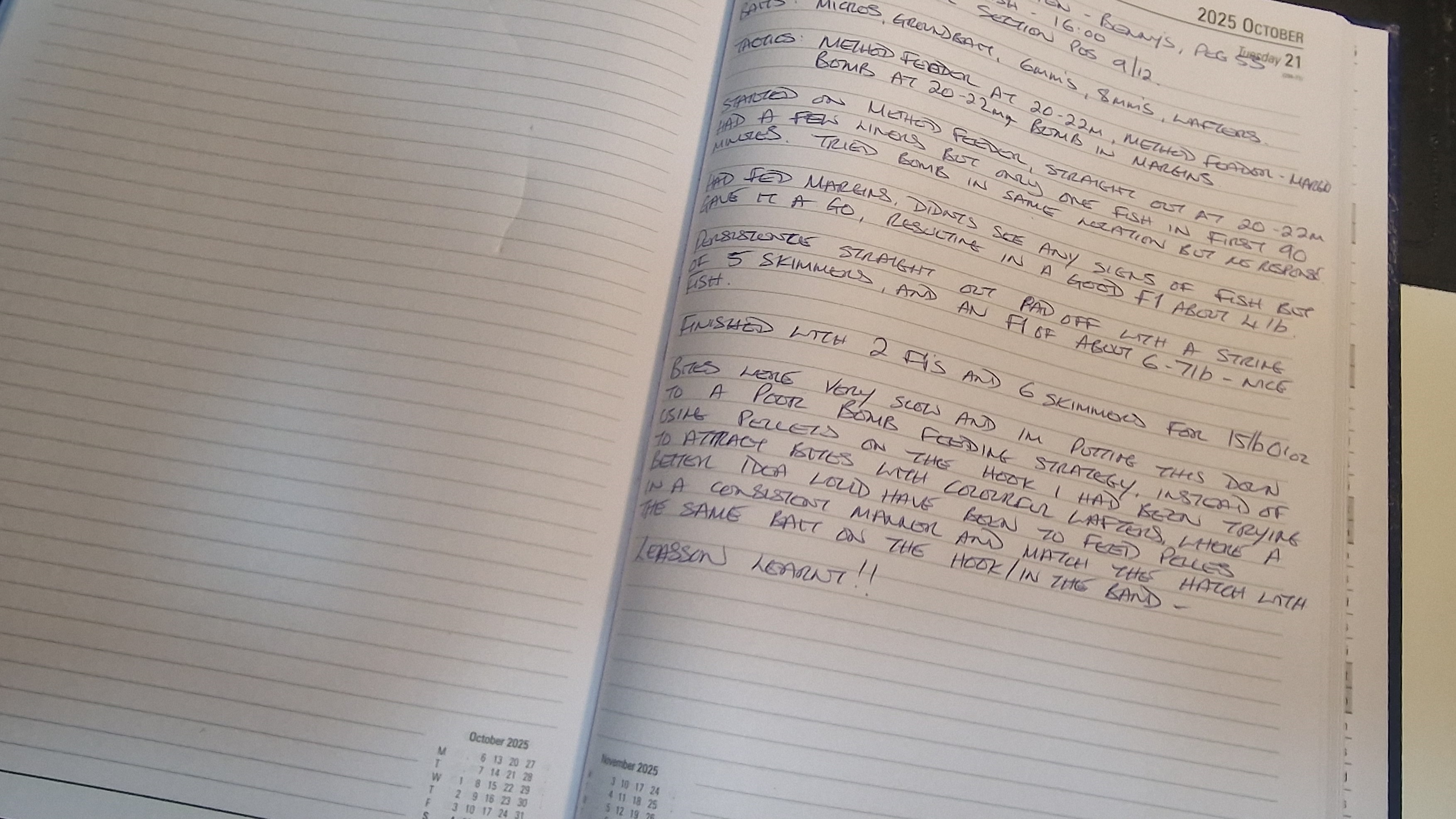
You don’t need to write essays. Five minutes of structured notes is enough to capture the crucial details. Over time, these build into a goldmine. At minimum, record:
-
Date and venue – anchoring the session in time and place.
-
Peg number – the most important detail. Patterns often repeat on specific pegs.
-
Weather conditions – temperature, wind, cloud cover; fish react strongly to weather shifts.
-
Rigs, elastics, and hook lengths – your tackle choices, so you can refine or repeat them.
-
Bait – what you fed, how much, and on which lines.
-
Feeding plan – rhythm and adjustments made during the match.
-
Results – weight, species caught, and how they came.
Optional extras might include water depth at each line, time of key catches, or any “X-factors” like bank disturbance, wildlife, or unusual behaviour.
The point is not writing beautifully, but capturing the mechanics of the day so you can read it back later and see what mattered.
Spotting Patterns
The real value comes over the long term. After a handful of sessions, your notes look like random snapshots. After a season, patterns leap out.
Maybe you’ll notice that carp at Aston Park always feed hard in the last two hours when the light drops. Maybe roach at Partridge Lakes line up on dead maggot every autumn. Or perhaps you’ll see that your margins only really pay off when fed little and often, not in one big dump.
These insights are priceless. They let you prepare before you even reach the peg. Instead of starting with guesswork, you start with evidence. That doesn’t guarantee success — fishing will always keep you humble — but it dramatically increases your odds of making the right calls.
The Long Game
Fishing diaries are like compound interest. The longer you keep one, the more valuable it becomes.
Year on year, your notes build a history of venues and pegs. You might not fish the same water for months, but when you return, you’ve got a ready-made playbook waiting. Imagine drawing peg 27 and instantly knowing from your notes: “Depth was six foot, skimmers fed mid-match on soft pellets, carp arrived late on corn.” That gives you a huge head start over the angler still scratching their head about where to start.
It also means you stop repeating mistakes. If your notes show you blanked three times feeding heavy groundbait in summer, you won’t make the same error a fourth time. Instead, you’ll adapt — and adaptation is the heart of match fishing success.
Practical Tools for Note-Keeping
There’s no single “right” way to keep a diary. What matters is finding a system you’ll actually use.
-
Notebooks: The classic approach. Compact, tactile, and always to hand. A hardback diary dedicated to fishing can become a treasured record.
-
Loose sheets or quick logs: Some anglers use laminated cards to jot notes bankside with a marker pen, then write them up properly at home.
-
Spreadsheets: Perfect if you like sorting and filtering by venue, peg, or species. Spreadsheets also let you run simple stats (average weights, top baits).
-
Apps: There are fishing log apps available, but beware the temptation to spend more time fiddling with your phone than watching your float.
Personally, I favour pen and paper. It’s less distracting on the bank, waterproof notebooks exist, and writing feels more direct. But whichever method keeps you consistent is the right one.
Turning Notes into Confidence
The biggest payoff from keeping notes is confidence. Fishing is full of doubt — “Am I feeding too much? Should I change bait? Was that a liner or a bite?” Having a record of what’s worked before settles those doubts.
Instead of guessing, you consult your diary. You see that last time on this peg, micros and expanders caught steadily. That memory, backed by notes, makes you commit to your plan with conviction. And conviction means you feed with rhythm, strike cleanly, and don’t waste time chopping and changing.
Confidence doesn’t guarantee success, but it almost always improves results. Anglers who believe in their methods fish better — sharper, calmer, and more consistent. A diary gives you that belief.
More Than Just Fishing
Keeping a fishing diary isn’t only about weights and rigs. It’s about reflection. Some anglers find that writing down the highs and lows becomes part of the enjoyment itself. It’s a way of savouring the best days and making sense of the tough ones.
There’s also a mental health aspect. Recording experiences helps process them. Writing down frustrations can help you let them go; writing down successes lets you relive them later. In this sense, a fishing diary is as much about wellbeing as it is about performance.
Final Thoughts
Match fishing is a game of fine margins. Often the difference between winning and mid-table is a handful of fish — the kind you’ll only catch if you’ve learned the lessons of your venue and peg. A diary is how you make sure those lessons stick.
The act of note-keeping is simple, but the benefits multiply over time. Patterns emerge, mistakes fade, confidence grows, and results follow. Whether you choose a battered notebook, a slick spreadsheet, or a handful of laminated cards, the message is the same: keep records.
Because while memory fades, ink doesn’t.