Hooklength length is one of those subjects anglers can spend far too much time debating. Four inches, six inches, short for carp, longer for silvers — there are good arguments for all of them, and for a long time I carried different lengths depending on what I was fishing for.
Over time, though, I've simplified my approach. For pole fishing I now use a standard 5-inch hooklength. It sits neatly between the traditional 4-inch and 6-inch options and, for the fishing I do, gives me the advantages I actually need without carrying two sets of virtually identical hooklengths.
Feeder fishing is different. There I still carry 4-inch, 8-inch and 12-inch hooklengths because changing the length can make a meaningful difference to how the feeder rig works.
Why Hooklength Length Matters
A couple of inches of line doesn't sound significant, but the hooklength is the final connection between the rig and your hookbait. Its length can affect several things:
Presentation — how freely and naturally the hookbait behaves.
Bite indication — how quickly movement at the hook is transmitted through the rig.
Control — how closely the hookbait works in relation to the shotting or feeder.
Rig simplicity — how many different hooklength combinations you need to prepare and carry.
There isn't one magic length that makes fish bite. Hooklength length is simply another part of the presentation, and it needs to make sense as part of the complete rig.
Why I Used to Carry 4-Inch and 6-Inch Hooklengths
There was good reasoning behind carrying both lengths. A 4-inch hooklength gives a short, direct connection between the hookbait and the rig. A 6-inch hooklength gives the bait another couple of inches of movement and can provide a slightly softer presentation.
That made it easy to create rules. Four inches for positive carp and F1 fishing; six inches for silvers, cautious fish or situations where I wanted a little more movement.
There was nothing fundamentally wrong with that system. It caught fish. But the more I used it, the more I questioned whether those two inches were making enough practical difference to justify carrying two complete sets of pole hooklengths.
Why I've Moved to 5 Inches
Five inches gives me a sensible compromise between the two.
It's short enough to retain the positive, controlled presentation I want when fishing pellets for carp and F1s, but it isn't so short that I feel I'm sacrificing the slightly softer presentation I might want for silvers or more cautious fish.
More importantly, it simplifies everything.
Instead of deciding whether today's rig needs a 4-inch or 6-inch hooklength, I tie my pole hooklengths at 5 inches and make the important decisions elsewhere in the rig — hook size, line diameter, bait, shotting, depth and feeding.
I'm not suggesting that 5 inches is some magical measurement that every angler should adopt. It isn't. It's simply a length that covers the range of pole fishing I do without introducing another decision that rarely changes the outcome enough to justify it.
One Length, Different Presentations
Standardising the hooklength doesn't mean every rig behaves the same way.
If I want a more positive presentation, I can alter the shotting and position the final shot closer to the hooklength. If I want the bait to fall more naturally, I can spread the shot or leave a greater distance between the last shot and the hook.
The hooklength can remain at 5 inches while the rest of the rig does the work.
That applies whether I'm fishing on the deck, shallow, down the margins or targeting silvers. I don't need a separate hooklength length for every situation.
Why Feeder Fishing Is Different
I don't apply the same 5-inch rule to feeder fishing because changing hooklength length has a much more distinct role in the way I set up my feeder rigs.
For feeder fishing I carry three standard lengths:
4-inch — my short, direct option, particularly where I want the hookbait close to the feeder and a positive setup.
8-inch — a useful middle ground when I want a little more separation and movement without going to a long hooklength.
12-inch — where I want greater separation from the feeder or a more natural presentation.
Those lengths are different enough to give me genuinely different presentations. That's the important distinction.
With pole fishing, I found myself carrying 4-inch and 6-inch hooklengths separated by only two inches. With feeder fishing, the difference between 4, 8 and 12 inches is substantial enough to change how the rig behaves.
My Standard System
My hooklength system is now much simpler than it used to be.
Pole fishing: 5-inch hooklengths.
Feeder fishing: 4-inch, 8-inch and 12-inch hooklengths.
Within those lengths I can still vary hook pattern, hook size and line diameter to suit the fish and conditions. I'm standardising the things that don't need constant variation while keeping the choices that genuinely affect the presentation.
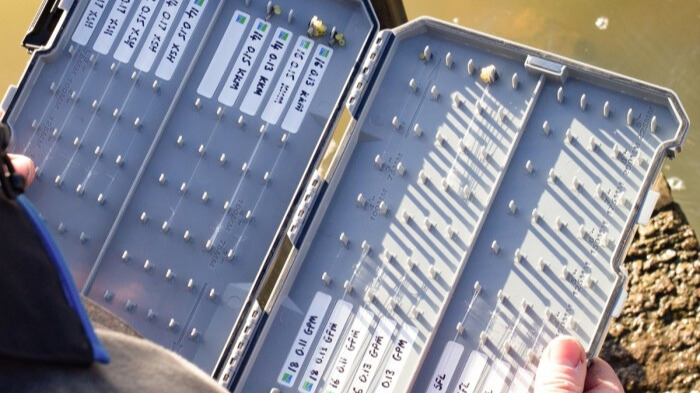
It also makes preparing hooklengths much easier. I can sit down at home, tie what I need and know exactly where everything belongs in the hook box. On the bank, there are fewer decisions and fewer almost-identical hooklengths to sort through.
Simplification Without Losing Flexibility
There's always a danger in fishing of carrying an answer for every possible problem. Before long you've got boxes full of slightly different rigs, hooks and hooklengths and spend more time deciding which one to use than actually fishing.
I've increasingly tried to simplify my tackle around a smaller number of setups that I understand and trust.
The important point is that simplification shouldn't remove useful choices. That's why I've standardised at 5 inches for the pole but retained three distinctly different feeder hooklengths.
One removes a choice I no longer think I need. The other preserves choices that still have a genuine purpose.
Confidence is Everything
Whatever hooklength length you choose, confidence still matters. An angler who understands their rig and concentrates on feeding, presentation and recognising what the fish are doing will generally be better served than one continually changing tackle because another angler uses something slightly different.
If you're perfectly happy using 4-inch or 6-inch pole hooklengths, there is no reason to change simply because I've settled on 5 inches. Both have caught an enormous number of fish and will continue to do so.
But if, like me, you find yourself carrying both and rarely see enough difference between them to justify it, 5 inches is worth considering.
Final Thoughts
My move to 5-inch pole hooklengths wasn't about discovering that 4 inches was wrong or 6 inches was wrong. It came from asking whether I really needed both.
For my fishing, I didn't.
Five inches gives me a practical middle ground for carp, F1s and silvers while making my hooklength system considerably simpler. I can change the behaviour of the rig through shotting, line, hook, bait and feeding rather than reaching for another hooklength simply because it is two inches longer or shorter.
On the feeder, I'll continue carrying 4-inch, 8-inch and 12-inch hooklengths because those lengths perform genuinely different jobs.
That's really the principle behind my current system: standardise where the difference doesn't matter enough, and keep the options where it does.