There's a particular kind of humiliation that comes from being scammed. Not the embarrassment of being fooled — though that's there too — but the specific, grinding shame of watching something you've worked hard to build quietly deflate in front of you. Resources gone. Plans shelved. The next match entry fee, the bait, the diesel, the food for the day — all of it suddenly out of reach.
We were scammed out of a considerable sum of money. I'm not going to dress that up or soften it. It happened, it hurt, and it has consequences that we're still living with day to day.
What makes it sting in a particular way for me is my background. I spent forty years in IT and IT security. I know how scams are engineered. I know the psychological mechanics behind them — the manufactured urgency, the promise of easy returns, the deliberate exploitation of trust. I've spent a significant part of my professional life helping organisations protect themselves against exactly these kinds of attacks. And yet here we are.
Courtney knew better too. She's aware of the risks and understands how these things work. But scams don't succeed because their victims are stupid. They succeed because they're built to exploit something real — a hope, a need, a moment of wanting something badly enough to override the voice that says wait. In this case, the promise of easy money to fund something she loves. That's a sharp hook, and it was well placed.
It's easy afterwards to point fingers when money disappears. Easy to ask how it happened, who should have spotted it, who should have said no. But those questions don't put the money back in the bank. They don't change what happened and they don't help you move forward. The only productive question becomes: what do we do next?
For us, the answer was simple, even if it wasn't particularly pleasant. We tightened our belts, cancelled plans, accepted that fishing would have to take a back seat for a while, and focused on getting through the immediate problem. Dwelling on blame might satisfy an emotional need in the moment, but it doesn't solve anything. Recovery starts when you stop looking backwards and start deciding what comes next.
So. We can't fish right now. Entry fees, bait, diesel, food for the bank — it all adds up to money that we simply don't have to spend. The bank will have to wait.
For people who don't fish, it probably sounds trivial. You simply don't go for a few weeks. But anglers know that's not how it works. Fishing isn't just a hobby. It's routine, anticipation, planning and escape all rolled into one. Even when you're not on the bank you're thinking about the next session, the next draw, the next venue. When that suddenly disappears because circumstances have taken the decision away from you, it leaves a surprisingly large gap.
But preparation doesn't stop just because the bank is out of reach.
Reviewing What's Already Happened
One of the habits that separates developing anglers from static ones is the willingness to review sessions honestly — not just to remember the good days, but to interrogate the decisions behind both the good and the bad ones.
I have match plans, detailed ones, built around a structured hour-by-hour framework, with decision points, golden rules, and pre-match checklists. But a match plan written in advance is a hypothesis. The session itself is the test. And the gap between what the plan anticipated and what actually happened is where the real learning lives.
Sitting at home, away from the bank, is actually a productive time to close that gap. What did I commit to too early? Where did I let emotion override the timer? Was there a moment where I knew what the fish were telling me and ignored it anyway? These are questions that deserve more than a shrug on the drive home. Writing them down, thinking them through, and feeding them back into the plans is work that makes the next session better — and it doesn't require a peg, a pole, or a bag of pellets.
The Tackle Is Getting Attention It Doesn't Usually Get
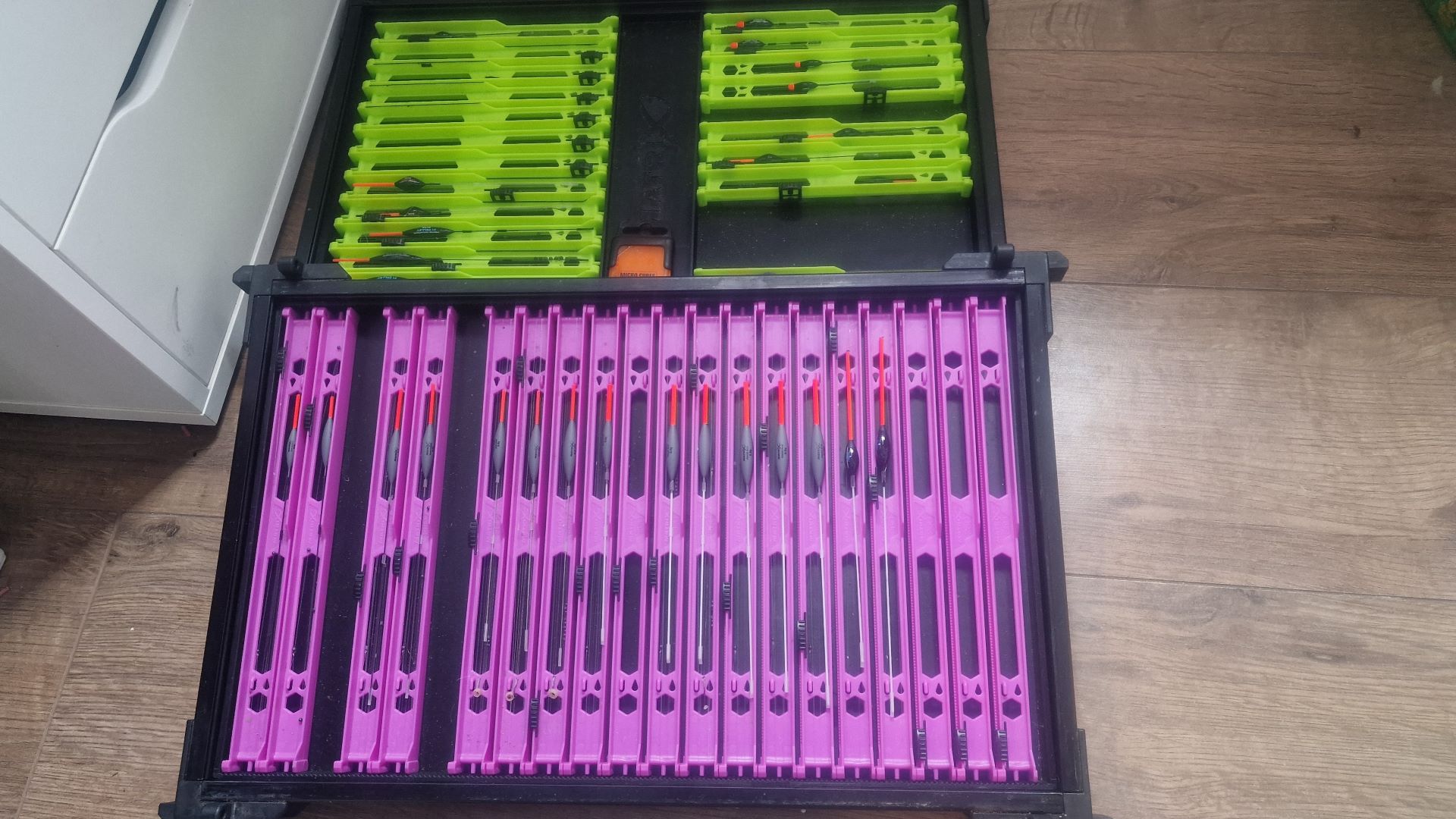
There's always something that doesn't quite get done between sessions. A reel line that's been on too long. A hooklength wallet that needs restocking. Shot sizes running low in one of the dispensers. Rigs that were built in a hurry and were always meant to be rebuilt properly.
Time away from fishing is time to fix all of it.
My reel lines are Matrix Horizon 0.20mm throughout — one standard, no variation. But even a consistent line has a lifespan, and it doesn't always get the attention it deserves when the next session is always around the corner. Right now, with no immediate session to prepare for, I can strip and re-line both reels properly, check every float for damage, go through the rig wallet systematically, and make sure the shot dispensers are full and in the right order.
None of this is glamorous. But arriving at a peg knowing that everything is right — that no reel is going to perform under par at the critical moment, that there isn't a rig with a compromised hooklength sitting in the winder tray — that matters. The time to find the problem is at home, not at the peg.
Study Doesn't Require a Licence
One of the things I've come to believe firmly is that the angler who arrives at a venue already knowing it has an edge that can't be bought with better tackle. Understanding a water — how it fishes in different conditions, which pegs hold fish in which wind directions, how the depth profile affects where fish sit at different times of year — is knowledge that accumulates over time and pays out consistently.
Right now I'm using the time to go back over venue footage, re-read session notes, and think carefully about the waters I fish most regularly. Lindholme Lakes is my primary venue. I know it reasonably well, but there are depths of knowledge I haven't reached yet. How does Benny's fish in a cold northeast wind versus a warm southwest? What does Loco do in the first hour when the weather changes mid-session? These questions have answers that experienced anglers at the venue already know. Some of that knowledge is in videos. Some of it is in conversations. All of it is worth pursuing.
Watching fishing content critically — not passively, but with specific questions in mind — is a different experience entirely. It's not entertainment, it's analysis. When a good angler catches consistently from a particular line, what are they doing that others aren't? What's the feeding pattern? How often are they shipping in? What do they do when the float stops moving? Asking those questions while watching costs nothing and pays back on the bank.
Deepening the System
Search-First Fishing — the decision framework at the heart of everything I do on the bank — is not something that gets fully understood in one session, or ten. It's a framework that rewards continued thought, and the deeper you understand it the more naturally it runs on the bank.
There's a version of match preparation that's entirely about logistics: the right bait, the right rigs, the right peg. And all of that matters. But the preparation that most anglers neglect is the mental kind — understanding why decisions are made, not just what decisions to make. Search-First exists precisely because most sessions are lost not through bad technique but through good technique applied at the wrong time. Committing too early. Feeding before learning. Changing two things at once and then not knowing which one made the difference.
Time away from the bank is time to sit with those principles. To think through scenarios. To ask: in that last session, at what point did I actually have enough information to commit — and did I wait for it? The answer, more often than I'd like, is that the commitment came before the evidence. Recognising that pattern, and understanding why it happens, is the work that eventually stops it from happening.
What Comes Next
The gap between now and the next session will close. It always does. Finances recover, circumstances change, and at some point the van will be loaded and the drive to Lindholme will happen again.
When it does, I want to arrive better prepared than I was before — not just logistically, but in the ways that are harder to measure. Calmer. More patient. More willing to sit with uncertainty in the early stages rather than reaching for a solution before the peg has offered one.
Being scammed is a genuinely horrible experience. The loss of money is the obvious part, but the loss of momentum — the sense of a project and a passion being put on pause against your will — is its own kind of damage. I won't pretend otherwise.
There was a version of me — forty years ago, younger, striving — for whom something like this would have felt like a verdict. I was building a career, supporting a family, measuring everything by forward momentum. A financial blow of this kind wouldn't just have been a setback. It would have felt like evidence of something. Proof that I wasn't good enough, hadn't been careful enough, had somehow failed a test I didn't know I was taking. I would have carried it differently. Harder. Longer.
Age changes that. Experience changes it. And if I'm honest, something else changed it too — something that happened a few years ago that has a habit of putting everything else into perspective without being asked. I know what an actual catastrophe feels like. I know what it feels like to have things that genuinely matter hanging in the balance. This isn't that. This is painful and frustrating and genuinely inconvenient, and I won't pretend otherwise. But it's survivable in the most straightforward sense of that word. Nobody died. We tighten our belts. We cancel the holiday we needed. We re-centre. And then we keep going, because that's what you do when the thing that's been taken from you is only money.
A Setback Is Not A Verdict
A setback is not a verdict. It never was.
When you've had a genuine brush with not being here at all, the category of things that actually matter gets radically simplified. Money is not in that category. Fishing is not in that category.
What matters is that we're both still here, still planning, still looking forward to the next draw.
Everything else is just weather.
The fish will still be there when we get back.