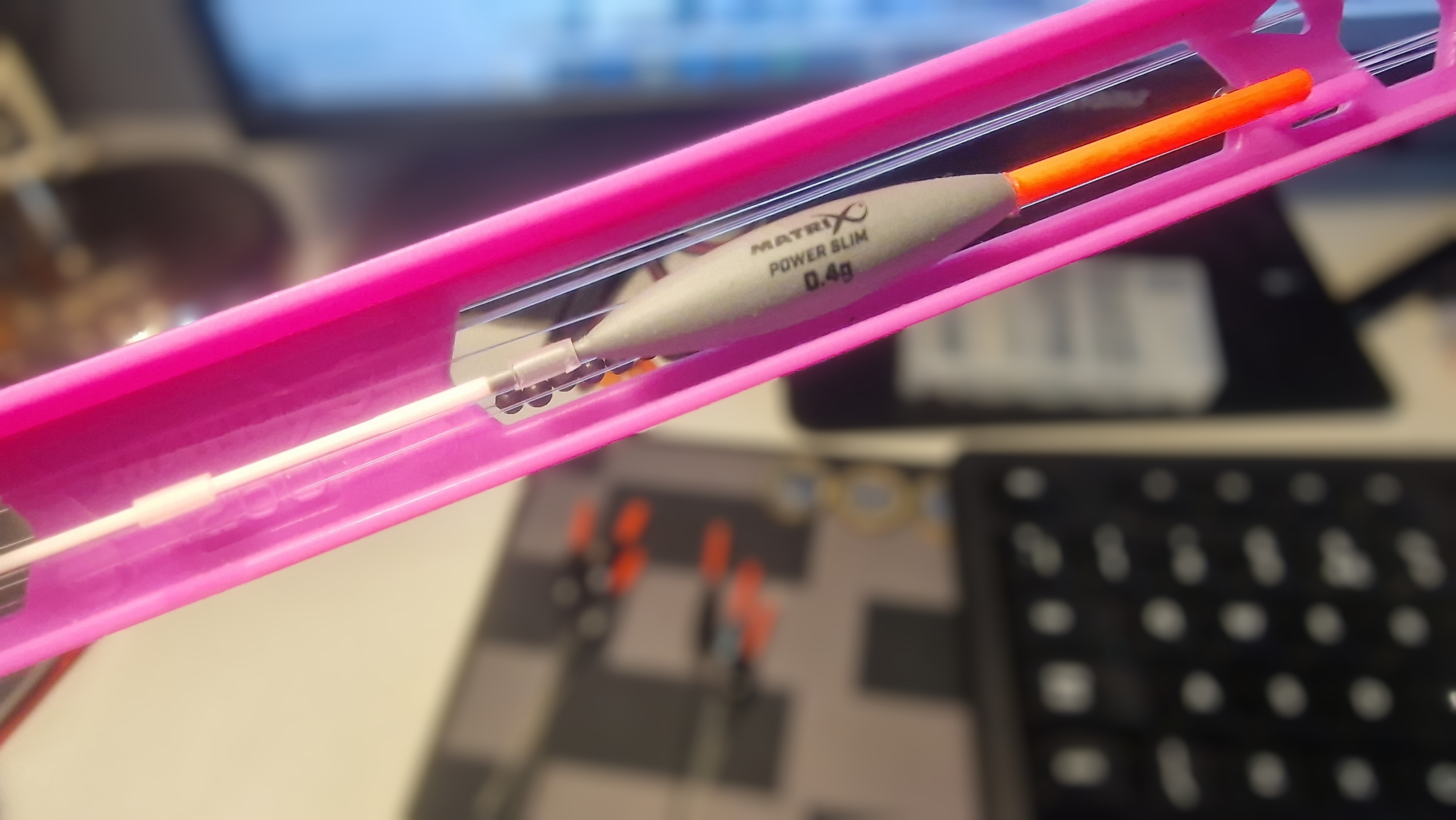

I remember the exact feeling. Preston — or was it Matrix, or Daiwa — had brought out a new float. Specifically designed, the packaging said, for fishing F1s on the bottom. Slightly different body profile. Different bristle diameter. A stem material that apparently offered something the previous stem material didn't. And I bought it. Of course I bought it. Because what if I drew a peg where F1s were on the bottom and I didn't have it?
That's how it starts.
Not with one float. With the entirely reasonable logic behind one float. And then another, and another, each one solving a problem the marketing department invented on your behalf, until one day you're standing at a peg with three float trays, somewhere in the region of seventy floats, and the uncomfortable realisation that perhaps eight of them will ever actually touch the water.
I've been there. That was me.
How Accumulation Happens
Nobody sets out to carry too much tackle. It creeps up on you, one entirely justifiable purchase at a time.
The mechanism is well understood once you see it. A manufacturer brings out a new product. The marketing identifies a scenario — a specific fish, a specific depth, a specific condition — where this product is the answer. The angler reads it, watches the video, sees the sponsored result, and feels the faint anxiety of not being prepared for that scenario. The purchase follows. The float goes in the tray. The scenario, more often than not, never quite materialises — and even when it does, the float already in the tray would have done the job perfectly well.
Multiply that process across floats, hooks, lines, shot patterns, elastics, and feeders, and you end up with a tackle collection that has been built by marketing departments rather than by deliberate thought. Every item arrived with a justification. Very few were ever asked a harder question: what specific job does this do that nothing I already own doesn't already do?
That question is the one that changes everything.
What It Actually Costs You
The obvious cost is money. Floats aren't cheap, hooks mount up, and a tackle shop visit with no clear list is an expensive afternoon. But that's not the cost I'm most interested in.
The real cost is paid on the bank, at exactly the moment when you can least afford it.
Match fishing asks you to make good decisions under pressure, often quickly, often when things aren't going to plan. That requires clarity. And clarity is precisely what disappears when you're staring into a tray of seventy floats trying to decide which one goes on the rig. It's not that you can't choose — it's that the act of choosing from too many options introduces noise at the moment you need signal. Decision fatigue is real, and it doesn't announce itself. It just quietly degrades the quality of your thinking when your thinking matters most.
I went from three float trays to one. From somewhere north of seventy floats to nineteen. The first thing I noticed wasn't that I caught more fish — though that came. The first thing I noticed was that the decision disappeared. I knew what float I was reaching for before I reached for it, because the system told me. There was nothing to deliberate about. The mental space that used to go on float selection went somewhere more useful instead.
The same principle runs through hooks. Twelve different patterns across three breaking strains per size isn't preparation. It's anxiety that has been allowed to go shopping. Five patterns, properly understood, cover every realistic situation on a commercial fishery. Not because the other seven patterns don't exist, or don't have a purpose somewhere — but because on the waters I fish, they don't have a purpose that one of my five doesn't already cover better.
Merit as the Only Filter
The question I now ask of every item in my kit is simple and non-negotiable: what specific job does this do, and is there anything already in my system that does that job?
If the answer is yes — if an existing float, hook, or rig already covers that situation — the new item doesn't come in. Not because I'm a minimalist, not because I'm trying to prove a point, but because a duplicate doesn't improve the system. It just adds noise.
If the answer is no — if there is a genuine situation that nothing currently in the kit handles well — then the item earns its place. Not on the basis of a marketing scenario, but on the basis of a real situation I have actually encountered, or can specifically anticipate at a venue I fish.
This is the difference between a curated system and an accumulated collection. A collection grows whenever something new appears. A system only grows when something new is genuinely needed.
Realisation
The turning point came one wet winter evening when I emptied every float tray onto the dining table.
What started as a simple attempt to tidy the tackle quickly turned into an uncomfortable audit. Float after float came out of the trays. Some I hadn't used in years. Some I couldn't remember buying. Some had been purchased for specific situations that had either never happened or had been handled perfectly well by another float already in the box.
Spread across the table was the physical evidence of years of accumulation. Every float had arrived with a reason. Every float had seemed necessary at the time. Yet looking at them together, it became obvious that many were solving exactly the same problem in slightly different ways.
That evening wasn't really about floats. It was about recognising the difference between owning tackle and understanding tackle.
Following the Logic: The Float Tray
Let me show you how the merit question actually works in practice, because describing it in the abstract doesn't do it justice.
I started with three float trays and somewhere north of seventy floats; pole floats, dibbers, insert carbons, wire stems, carbon stems, diamond bodies, round bodies, floats I'd bought for specific venues, floats I'd bought because they were on offer, floats I'd bought because a sponsored angler was catching on them in a YouTube video and I wanted what he had.
The process of reducing that to nineteen started with a single question asked of every float in the tray: what specific job does this float do in the water, and does anything else in here already do that job?
The first float I picked up was a slim-bodied carbon stem float with a spread bulk shotting pattern. What does it do? The carbon stem transmits movement sensitively. The spread bulk creates a slow, natural fall through the water column. That slow fall means a bait passing through every depth on the way down — fish at any level get the chance to intercept it. What that float is actually doing is gathering information. It's telling me whether fish are on the deck, up in the water, or somewhere in between. It's the first float into the water on any session.
Does anything else do that job? No. It stays.
The next float: a slim carbon stem with a tapered shotting pattern — shot sizes reducing progressively down the line, creating a graduated deceleration as the bait falls. What does it do differently to the first float? Where the spread bulk falls slowly throughout, the tapered pattern targets a specific depth zone. It's not gathering information — it's using information already gathered to search a particular layer of the water with purpose. It confirms the feeding depth before the commitment to a dedicated shallow rig is made.
Different job. It stays.
Then a wire stem float, bulk plus two droppers. The wire stem is heavier than carbon relative to its size — it settles the rig more actively, stabilises it on the deck. The bulk drives the bait down efficiently. This float isn't searching. It isn't gathering information. It knows the fish are on the bottom and its entire purpose is to get the bait there quickly and report positive takes. Pure conversion.
Different job again. It stays.
Now things start getting interesting. I picked up float after float that claimed, through its shape or its stem material or its bristle diameter, to be doing something distinct — but when I asked the honest question, it was doing the same job as something already in the kept pile, just slightly differently dressed. A wire stem float with a slightly fatter body. Another carbon stem with a marginally longer bristle. A float I'd bought because it was described as ideal for F1s at distance — but when I asked what it actually did in the water, it did exactly what the wire stem bottom float already did, just with more buoyancy I didn't need.
Those floats left the tray.
The ones that stayed each answered the question cleanly. The Power Stem — fibreglass, thicker bristle — for big fish and rough conditions where finer floats get compromised. The Dibber for shallow fishing, pre-set rigs, the slap of the float onto the surface as a feed trigger. The Rough Weather float with its diamond body profile for crosswind and undertow conditions where a slim float becomes unreadable. The Jigga for self-hooking mid-water presentation when fish are neither properly on the deck nor properly shallow.
Seven types. Nineteen floats in total across those types, covering the size range each one needs. One tray. No cassette under the box.
Every float that left the tray left because it couldn't answer the merit question honestly. Not because it was a bad float — some of them were excellent. But excellent at a job that was already covered.
That's the process. It's not complicated. It's just honest.
What a Merit-Based System Looks Like in Practice
Nineteen floats. Five hook patterns in three sizes. One reel line diameter for both of us, no variation. Hooklengths on a single consistent standard, stepped by season. Shot in three sizes, chosen specifically because the weights are consistent between batches — because inconsistent shot disrupts pre-calculated rigs in ways that matter.
None of this was arrived at quickly. It came from a deliberate process of asking the merit question of everything in the kit, removing what couldn't answer it, and rebuilding from what remained. The result isn't a stripped-back version of the old system. It's a different kind of system entirely — one where every item knows its job, and the angler knows every item.
The practical effect on the bank is significant. Setup is faster. Decisions are cleaner. When something isn't working, the diagnosis is clearer because there are fewer variables to interrogate. And the confidence that comes from a system you genuinely understand — rather than a collection you're hoping covers all eventualities — is something that's very difficult to put a number on but very easy to feel.
The Harder Question
Here's the thing about carrying too much tackle. It feels like preparation. It feels responsible, thorough, ready for anything. The angler with three float trays and a tackle bag that takes two trips from the car isn't being careless — they're trying to be prepared.
But preparation and accumulation aren't the same thing. Real preparation is knowing exactly what you have, exactly why you have it, and exactly when to use it. That knowledge is only possible when the kit is small enough to genuinely know.
The next time something new catches your eye — a float with a slightly different body profile, a hook pattern aimed at a specific scenario, a line diameter that splits the difference between two you already carry — ask the merit question before you reach for your wallet. What specific job does this do? Does anything I already own do that job?
If the answer is honest, the tackle bag gets lighter. And the fishing, almost certainly, gets better.